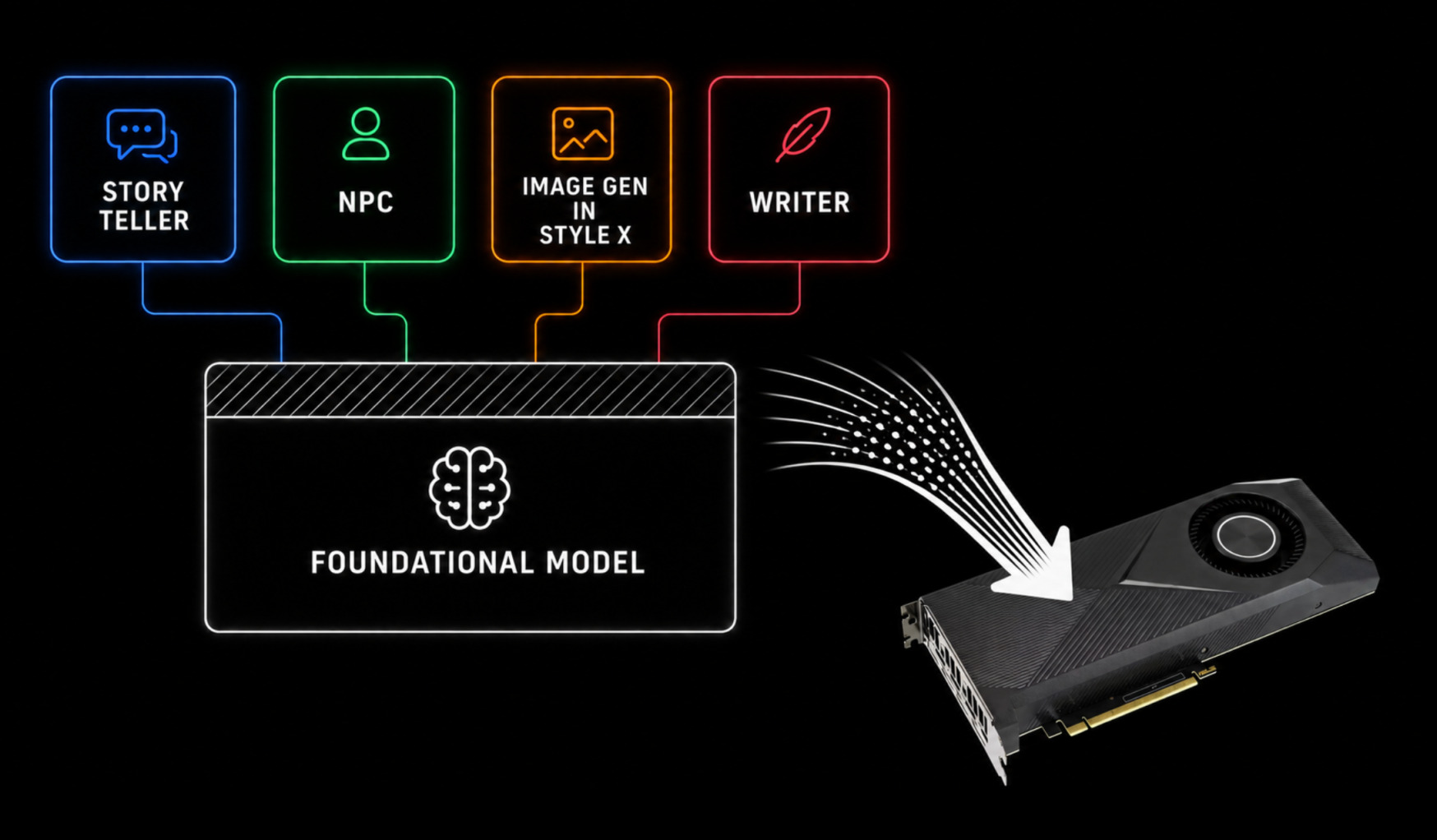
Using LLMs to power game agents is really underrated. They can reason about goals, respond to player intent, coordinate tools, remember context, and help worlds feel alive in ways that traditional scripting alone cannot.
But there are three big reasons most teams are not building this way yet: it is expensive, it is hard to develop, and general-purpose models are not naturally aligned with great game design. A cloud-hosted agent swarm can cost hundreds of dollars per day, and even then it may behave more like a chatbot than a game system.
We are solving this by training our own game-agent models on top of foundation LLMs. The goal is not bigger models for their own sake; it is smaller, specialized, controllable models that understand game state, game tools, and player experience — and can run locally on consumer GPUs with zero cloud inference cost.
That changes the design equation. If agents can run locally, we can afford persistent worlds, long-running simulations, rapid iteration, and experiments that would be impractical if every agent thought cost money in the cloud.
Why this matters
- Local inference makes agent-heavy games financially viable.
- Specialized game-agent models can be easier to constrain, test, and tune.
- Human-led design stays in control when models operate through authored tools and rules.
Explore the new site to see more of what we are building. We are going to keep sharing what we learn as we develop the next generation of AI-native games — and if you are genuinely interested, drop us a message.